Search This Blog

Thursday, January 14, 2010

DENIM DRY PROCESSING


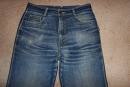
The distressed jeans that we see around everywhere undergo a wide variety of wet as well as dry treatments to get the desired effects. Here I shall try to explain some basic Denim Dry Processing techniques. In the creation of vintage denim jeans, dry processes play a very important role and hence important to understand.

Denim Dry Processing - Basic know how

Destroying denims is as much an art as it is a technique. Details are added using a fine abrasive paper on a scraping tool. And extra whiskering can be added with sand paper. Sometimes a bit of local tint staining is being done into the local areas to emphasize the lighter parts.

The jeans then go for a washing with pumice stone to blend in the whiskering and tinting / over dyeing. Where the folds and wrinkles go is where the art part comes in, it’s often through observation of where wear patterns are typically found. For some of mine I have several pairs of old well worn thrift store jeans that I use as a template to guide where I want the wear patterns. I chalk in where I want the details and then they are finished off site by me in my finish workshop. Some of what is done to customize jeans are patented secrets, no one other than those who work for these companies knows the exact techniques or the abrasives and chemicals used to achieve certain special effects.

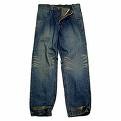
Below is list of operations being carried out on denim garment to achieve VINTAGE (used/worn out) look……
  • Hand Sand / Hand Scraping
  • Sand blasting
  • Whiskers
  • Chevrons
  • Knee Star / knee whiskers
  • Hot Spot
  • Tacking
  • Grinding
  • Damages / Destruction
  • PP Spray
  • PP Brush / towel
  • Patch / repair
  • Bleach spots
  • Resin application
  • Pigments & Local tint application etc….
.
1.Denim Hand Sand / Scraping


Hand sand is step which is generally being done in rigid form of garments to get distress look. Locations can be front thigh & back seat or its can be overall / global application as per Standard. Emery paper is being used to scrape the garments in particular placement & design. Emery paper comes in different number generally start from 40 till 600 and above , higher the number finer the emery paper, lower the coarseness of the paper. In garment industry from 220 , 320 & 400 number papers are most popular & widely used.


Purpose of doing this process is make used worn out look to the garments.
The most important factor is to select right number of paper according to the fabric strength & intensity need. Feathering / merging white sanded part to dark blue area in such way that it should look natural & not artificial.

Scraping can be done on inflated rubber balloons for better effect ( horizontal or vertical its up to operators convenience ) , even it can done plain wooden board of garment size & hand pressure should be uniform in order to get better results.

Hand sanding must be started from intense part & feathering out on less intense part gradually. One garment must by done by one operator only to have balance intensity on both the legs.

2.Sand Blasting


This process is isolated now a days due to health hazards & buyers do not like the results of sandblast because its covers the characteristics of fabric. This process being done by using different kin d of sand blown to garments with air pressure to rub out the color.

3.Whiskers/ Moustaches , Chevron , Knee Star, Hot Spot


On Denim, whiskers / Mustaches , Chevrons are nothing but the worn out lines / impression generated by natural wearing on hip & thigh area. There are many designs & pattern available.
This is being done manually with help of sharp edge Emery paper rolled on fine wood stick or pasted on plastic material. Before starting execution placements & pattern must be marked on garments, this will help operator to execute the pattern right to match the aesthetics of garment.
Hot spots are heavy/intense area on thigh or knee which is made purposely to create used look & on knee area if any whiskers line are there, called knee star.

All above operations are carried out in width direction hence its appears intense than hand sand with less strokes, because hand sand is carried out in length direction.


4.Tacking & Grinding

Tacking: is a process which is being done by swift tag machine with the help of plastic or nylon tag pins in rigid form of garment to get very heavy contrast ( rigid & washed ) on waistband, bottom hems, back pocket & front pocket corners etc.. after completing wash cycle, it must be removed from garment before making softening.

Grinding: is being done on pocket edges & bottom hems edges by running against abrasion surface or stone to achieve worn out effect. Many different make of machines & pen grinding tools are available in the market which runs with pneumatic system.

5.Damages/Destruction


One of the most popular distressing effects currently , ‘Destruction’ is an art which make denim look unique & used. To make destruction pen type of stone tools being used in mid of wash process to apply on desired area. It can also be achieved by cutting it thru knife the warp yarns & keep the weft yarn as is to show white thread. Holes also can be made by cutting weft & warp yarns. These are all manual processes & every garment will look unique & different than others.

6.POTASSIUM PERMANGNATE SPRAY/RUB & BLEACH SPRAY


PP Spray is being done on denim garments to achieve local abraded area to appear whiter than back ground indigo color shade. This can be applied by spray gun or by towel dipped in to PP Solution & rubbed on desired area followed by neutralization in wet process. This process can be done in rigid after doing hand scrape or in the middle of the wash. Doing after enzyme or bleach cycle will give more natural & white effect that doing in rigid. There are many additives can be added in order to achieve desired intensity and look.

The same way bleach solution also can be spray or rubbed on the garments on desired area. But this process is very complicated & needs highly skilled operators to execute it followed by immediate neutralization.
There are many parameters needs to be taken into control for doing PP or Bleach spray…. Spray gun pressure, width of spray, flow & way of spraying.

Note:Safety of operators must be taken in to consideration and it must be ensured that he should wear mask, gloves & eye glasses etc…

7.Patch & Repairs along with Bleach Spots


These are totally manual processes to give uniqueness to Denim and to make it look VINTAGE. First cut or damage the units intestinally to desired area & then make hand repairs or machine repair to look natural. Diluted bleach can be used to spot the desired area followed by neutralization in wet process.
These process are time consuming hence productivity is low & reproducibility is very difficult but similar aesthetics can be achieved.

When we talk about Vintage denim, every garment should look unique & not a photocopy !. These garments are sold at very high prices so customer should have a feeling of uniqueness & feeling different from others. Vintage denim are signature/ autograph of a brand & its image.

8.Resin Application( 3D Effect )


Resin ( Formaldehyde free ) being used for achieving 3D effect ( 3 Dimensional ), Rigid Look etc. This process can be done by spraying or dipping the garments in to Resin, Catalyst, Silicone & PU solution in right combination according to the fabric strength & desired effect needed. After application of resin solution in right proportion, make manual designing as needed on the thigh, hip & back knee area to get 3Dimentional effect. After making it , it should be manually dried with hot press or hair dryer & then must be cured in oven at right temperature, time as mentioned in resin product manual.

If resin not cured properly , 3 D effect will not be permanent & can cause skin irritation/rashes to the wearer. Highly skilled operators needs to execute this process in order to get consistency & uniformity.
Whole garment can have crushed look by resin dip & crushed manually followed by oven curing. Silicone plays an important role in getting softer hand after oven.

Special streaky effect & Crackles also being done by applying resin on desired area followed by scraping & pp spray then neutralization.

9.Pigments & Local Tint ( Staining) Application

Need to choose right color of pigment or tint with binder or fixer to apply locally on denim to get vintage look. This process also needs an artist to execute it nicely to merge the tint with ground indigo color & should not look too artificial. Pigments & Local tint also can be applied through spray gun or rubbing on desired area of denim garment. After application its must be cured in order to have permanent effect on jean.
As we can see from all the dry denim processes mentioned above, they are mainly manual processes. The quality of the worker can make or break the garment. Hence , great care has to be given to select the right personnel for these jobs.

Wednesday, January 13, 2010

ACID WASHES ON DENIM JEANS


Acid wash is again becoming popular on denim jeans and we are going to see more of acid washes in the coming seasons. Here , lets have a quick look at the acid washing process .
An acid wash finish treatment creates significant contrasts in the color of the denim material. It can be done on Indigo & Sulphur base fabric garments. As the randomly faded, acid washed style came into vogue in 1980s, the process of treating denim in such a way began to become increasingly refined. Some tried to use a method similar to the stonewashing, yet the fading did not occur as dramatically or throughout the material.

In 1980’s this washed being launched as first innovative finish on denim ever. This was being done by soaking stones in Bleach and making acid wash effect followed by neutralization. But this process was not so re find to get some how consistent & smooth effect on denim. In early 2000 some laundry tried doing the same wash soaking thermocol bolls in bleach or pp solution to get this desired effect. While this process can be done using either light bleach, chlorine , potassium permanganate etc.

The most popular is PP Bleach and will produce the best acid washed results. Doing the process is very simple , but following all parameters in correct way to have right & repeatable results. The load size of garments, machine drum diameter, quantity of soaked stone / towels & skilled operator. Initially, the Acid Wash process involved soaking pumice in Industrial Strength Chlorine .

However, it was discovered that potassium permanganate was more controllable and just as strong an oxidizer. They simply marinated pumice stone in it and then vacuum packed the stone to the required moisture level. Acid wash was a chemical process on denim that stripped the top layer of color off to a white surface with the undertones of navy blue remaining in the jeans.

The Materials

The process of acid washing jeans involves porous pumice stones or small towel pieces and chlorine or Pp Bleach, such as you would put into a bucket or in drum for soaking process. Sodium-bisulfate is used in the second washing for Neutralization. Also recommended is access to two separate washing machines. One for Acid Washing & another one for further process i.e. Neutralization etc.

The Acid Washing Process On Denim Jeans

The process of acid washing jeans used chemicals, stripping off the color of the top layer, leaving the white fabric exposed. The color remained in the lower layers of the material, giving it a faded look. Acid washing could be done overall or made to look splotchy.


1.Soak porous pumice rocks or pieces of towels in chlorine or PP bleach solution for about 20 minutes to an hour. The longer you soak the pumice or towel, the more prominent the effects will be.

2.Once the stones are saturated with chlorine/pp, remove excess water from stones/towel then put the stones in machine followed by the jeans in a washing machine for about 20 minutes. Make sure machine do not have single drop of water, open the drain during complete process

3.At this time, check on the jeans to ensure they look acceptable, and then move them to another washing machine for a regular washing process. Too long in the first machine can totally bleach or ruin the jeans, and too little time may not produce the desired results or can make patchy appearance. Check on the jeans once every 10 minutes or so during the second wash process of neutralisation to ensure the desired look is achieved.

4.Next, fully dry the jeans in a dryer that gets nice and hot.

Precautions

Any time we mess with chemicals such as bleach or chlorine or PP, be sure to protect workers by wearing mask & aprons , so it is best to be fully prepared. Also, protective rubber gloves and safety glasses are highly recommended. These products can burn skin and eyes pretty badly. About Author : 3E’s Consultants, Group of experts, focused on Denim Fashion, Providing consultancy to all Denim Garments Finishers

Tuesday, January 12, 2010

INDIGO-DYEING


INDIGO- DYEING VARIOUS METHODS
EXPLAINED AND COMPARED


The indigo dyeing and processing methods -currently used – for dyeing indigo warps were introduced from 1978- 1987 to obtain a higher productivity and savings in dyeing or to achieve the required darker shades (hard rock washing, super blue, soft denim), or softness of the yarn for final finishing. The following table gives you a comparison of the possible processing stages such as:

1- Indigo rope dyeing process
2- Indigo one sheet dye slashing
3- Indigo double sheet dyeing
4- Loop dye 1 for 6 (continuous dye slashing)
5- Loop dye 1 for 6 with dyemer (continuous mercerization dyeing and sizing).

For the five major Indigo dyeing methods for the basic denim, super blue denim, soft denim, stone wash denim, we also must take into consideration that a certain appearance of the garments is only achieved after a certain washing method. (Chemical washing, stone washing, hard rock washing), use of certain sizing agents (soft denim) or irregular appearance in warp or weft direction by using a yarn with slubs and neps (antic denim).

The final finishing methods have influence on fabric construction and dyeing methods.

CHEMICAL WASHED DENIM

The creator of snow wash denim or of f-side denim is Edwin Co. Limited Japan. These chemical washed types of ready made garments show less tensile strength and a harder hand.

STONE WASHING

With soft stones it takes 20 – 30 min. to achieve the desire surface appearance.

DRY BLEACH


Soft rock are socked with chloride and the garment treated in washing machines.

HARD STONE WASHING

Treatment takes approx. 3 – 4 hours. A very soft hand the garments is achieved. Due to the extended time of treatment in washing with hard rocks the strength of fabric is influenced. This treatment requires improved yarn quality and deeper dyed shades. Hard stone washing fades out partly at hems and stitched lines.

SUPER BLUE

Deepness shade is achieved by dyeing in 8 – 12 dye boxes with rope dyeing methods. With mercerized yarn where the colour stays at the surface of the yarn (ring dyeing) with continuous loop dye range with integrated mercerizing and dyeing unit (dyemer).

BLACK DENIM

Sulfur dyed, padazoic dyed etc. on continuous dyeing sizing machines or loop dye ranges.

INDIGO DYESTUFF AND ITS CHARATERISTICS


Indigo has despite many other blue dyestuffs kept its popularity. This by no doubt is achieved by the fact that Indigo has a number of properties which have in this combination not yet been achieved by other single dyestuffs. The main properties are:

  • Pleasant colour shade.


  • Possibility to achieve by simple repeated dipping, deep marine blue shade.


  • Possibility to dye cotton in cold dye bath.


  • Competitive in price.

Possibility to achieve an acceptable colour fastness and the exceptional advantage by repeated washing of fading colour, to keep the colour shade that always a clear, pleasant blue shade result. The following drawing shows the symbolic built-up of dye stuff of the yarn according to the multi-deep process.


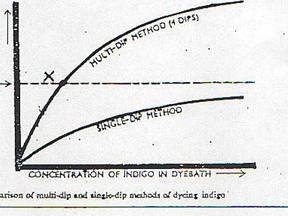
The sketch shows how Indigo layers one after the other are placed on the surface of the yarn then again scraped off, similar to knife through force or tension or by washing. An Indigo has only a very low affinity and the depth of colour of the fibre is achieved by repeated dipping / oxidation. Each dipping cycle occur in a certain balanced manner as dye stuff is observed by the fibre at the same time and part of the already
oxidized dye stuff is reduced and migrates from the fibres.


With increasing dipping operations , the balance of absorption / migration moves towards migration.
A very important factor for the reduction of migration is the squeezing effect and the oxidation which follows. A high squeezing effect promotes a quick and thorough oxidation and reduces the migration and reduction in the following bye bath.

With the low squeezing effect ie with high liquid absorption, the purely visual impression of a good oxidation can be deceptive as the outer colour skin looks blue. In the core of the thread however less vat dye stuff may be deposited Let us have a close look at the different dyeing systems.


CONVENTIONAL CLASSICAL

CONTINUOUS INDIGO ROPE DYEING

The classical rope dyeing system is very labor intensive and consists of:

  • Ball warping


  • Indigo dyeing


  • Rebeaming on long- chain-beamer


  • Sizing

Yarn from the ring spinning machine is wound on automatic winding machines on to a suitable package either cylindrical or 5057 cone. The winders are directly linked to the ring spinning frames and the cops joint by splicing. OE yarns are directly creeled up on the Ball warper.

The required No. of ends (usually 380 – 420 ends) are assembled into a rope. These ends are wound onto a core. The rope is guided similar as a cross wound package and wound into a ball, length of ball approx. 12 – 15.000 meters.

A lease is inserted at the start and end of the rope. The facilitate Rebeaming every 1000 meters an additional lease is inserted. Usually 18 – 24 ropes are simultaneously process on the rope dyeing machine. Prior to dyeing, the ropes are boiled out and treated with caustic-soda and wetting agent to remove from the cotton oil, impurities which could influence the fastness for the dye.

To dye with indigo, the ropes are immersed into the dye-bath. To dye in rope 30 – 60 seconds immersion (20 meters yarn) and 60 - 180 seconds are required for the oxidation of the Indigo dyestuff to ensure that also ends in the centre of the rope are equally dyed. Please note that squeezing pressure is important- 5 tons- as fastness of colour and shade depends on even squeezing pressure. The comparatively long immersion and oxidation time requires a comparatively expensive equipment of machinery.

In order to obtain the required deep shade of blue colour the ropes are immersed 5 – 6 times in a sequence of dye boxes with an oxidation range - so called skying - after each dye box. (Indigo belongs to the group of the vat dyes which is water-soluble in reduced solution and becomes an insoluble pigment when oxidized.


Having passed the dyeing and oxidation rage the ropes are guided through 2 or 3 washing boxes to wash off excessive dye .In the last box softener are added to ease the opening of the ropes. They are dried in a series of cans. The dried ropes which contain 380 – 420 ends are then deposited into large coilers .Rebeaming with 300 – 380 ends per rope is easier. These coilers are placed behind the long chain beamer where the Rebeaming and opening of the ropes takes place. In order to guarantee even yarn tension through Rebeaming on to a back beam ready for sizing the ropes are guided over a tension device which is placed approx. 10 -11 meters distance from the long chain beamer. Broken ends which very really happen during process of the rope dyeing are repaired at this process stage. Initially these machines were supplied without yarn stop motion but are available now a days on special request. This is of major importance as lost ends, fluff, 3 – tail ends and yarn remnants can cause inferior performance in weaving.

The so prepared beck beams are now sized in a sizing machine preferably with 2 size boxes. The size pick up varies between 8 – 10%. In Europe mainly modified starches with binders are used, whilst in USA certain low % of PVA is applied in combination with starches by some companies. Depending on the final finishing process (washed denim) with no filler also CMC gives excellent performance in weaving. Special size mixes for soft denim will be discussed separately. We recommend however not to use PVA for sizing of denim as a surface of denim may show a leather skinned appearance.

CONTINUOUS SLASHER DYEING SYSTEM

Contrary to the Indigo rope dyeing system, for the continuous slasher dyeing and sizing back beams are used. That means that the total No of ends required for a weavers beam are dyed, dried, sized and dried simultaneously. The back beam contains similar to rope 380 – 420 ends but distributed evenly over the width of 140 or 160 cm between the flanges so the end lay parallel to each other, warp length 12 – 15.000 meters, similar to the rope dyeing system the full No of ends are pretreated (washed) dyed in 4 dye boxes and oxidized, no softener are used in the last wash box.

CONTINUOUS INDIGO DYEING AND SIZING PROCESS

We must however consider that the squeezing effect is lower and therefore the danger of streakiness and shade variation from centre to out side is also higher. Consequently it would be better to reduce the warping width rather to 140 cm instead of using warper beams with 160 – 180 cm warping width.
The immersion time in the dye boxes is approx. 10 – 15 seconds and time for oxidation 30 – 60 second. The final result is a weaver’s beam. This system allows the installation of less expensive dye rage and less additional preparatory machinery.

One of the disadvantages previously when warp preparation (knots, weak, thick places) was not kept at a very high level was that ends sown in the dyeing range could cause major color variation through machine stops.

DOUBLE SHEET CONTINUOUS DYEING

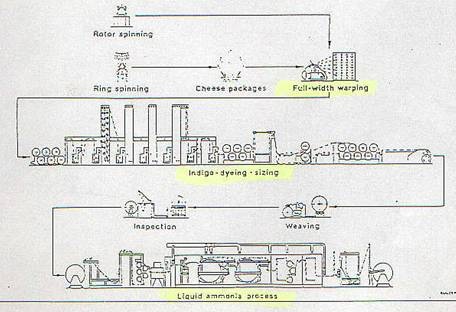
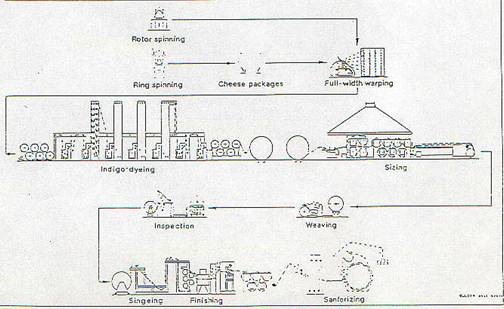
Patents applied for double shade dyeing by E. Godau date back as 1976. With the system dyeing sizing is done in 2 operations. The main reason for dyeing of 2 sheet simultaneously is achieved a more even dyed sheet, that means 8000 – 8200 end are dyed, oxidized, dried and the full length of the warper beam 12.000 – 15.000 meters flange diameter. These beams are transported with the aid of air cushions to the sizing machine and the yarn sheet sized in double size boxes. Immersion time and oxidation time is the same as with continuous slasher dyeing. Indigo full-width warping process


With double sheet dyeing the linear warp thread density is doubled. Therefore: Squeezing effect is increased,
An even squeezing over the whole width is achieved, Condensation and concentration of ends at one spot show compared to single sheet dyeing no colour strips formation, streakiness or shading in the finished fabric. The production out put of the dyeing is increased by 75%. Dyeing of 3 layers of yarn simultaneously is possible but very difficult to control the beaming on 3 big warp batches.

Unfortunately the double sheet dyeing machine as well as the rope dyeing range cannot be linked with a sizing machine which must be regarded as disadvantage as the processes of dyeing and sizing must be carried out separately.
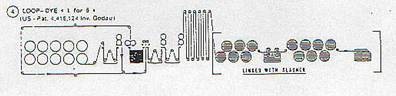
Loop dye system 1 for 6

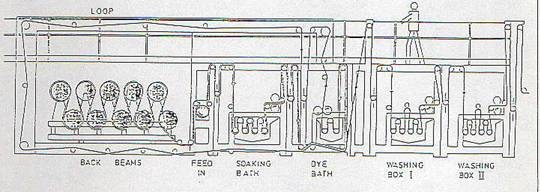
Similar to the sheet dyeing systems 10 – 16 warper beams with the total number of ends required for the weaver beams are used. The warper beams are placed in a moveable warp creel which can be loaded whilst one set is in potation.


The yarn sheet is guided to the soaking bath through a feed-in system with tension compensation rollers. The soaking bath has the task to prepare the yarn for the following dyeing operation.

The yarn sheet after having been immersed into a single indigo dye bath runs into a long loop where oxidation takes place. As you can see from the slide the back beams are inside the yarn sheet passes through the dye box as often as necessary to obtain the required deepness of shade. One of the advantages is:

Ideal, utilization of Hydrosulphite through squeezing 4 – 6 layers simultaneously and oxidation of yarn in a comparatively long oxidation loop. After the oxidation the yarn sheet is guided through 2 washing boxes into a yarn accumulator and finally on to a series of drying cans, dried up to 25 – 30% final moisture content prior being immersed into size boxes, dried and wound onto a weavers beam.


The molecules are controlled DC drive to maintain warp tensions. Temperatures are automatically controlled as well as the PH value in the dye box. The automatic control unit of the PH value supplies automatically hydrosulfite and caustic soda to stabilize the present value from the start to end of a dye set.

All rollers arein contact with the dyed sheet are fluted, they keep the sheet in position and reduce deposit of dye and build-up of other deposit (fluff). In addition to width is controlled by guides to ensure even distribution of the yarn layer over the whole width of the dyed sheet. All accumulators placed between washing boxes and drying cans guarantees a continuous production of the dye range when a weaver beam has to be exchanged at the head stock. The creels can be loaded with back beam with 1200 mm diameter which allows to warp approx. 36.800 meters of yarn, count No 7, 5 (tex 78) or 50.000 m count No 10 (tex 60). This means that depending on the count normally one cyl-spool is used in warping to fill a warper beam.

WARPING SPEED

PRODUCTION

Speed varies between 1000 m/min, 35 m/min. No 5, 5 (tex 107) and 42 m/min. No 10 (tex 60)

MACHINE STOPS DURING SIZING

For 36800 m, 4 recorded on expansion comb.

WASTE OF MATERIAL

Approx. 15-20 kg per set.

TIME REQUIRED FOR CHANGE OF SET

2 hour

LINEAR WARP DENSITIES IN THE SQUEEZE

The linear density in the nip is calculated in the same manner as for sizing.

Q= linear thread density

F= ends in cm -1

D= diameter of yarn

D= 0,921 mm = 0,921 = 0, 29125

Nm 10 = 3.1622

Q= F x D

As already mentioned previously the warp density has an influence on colour fastness. A higher squeezing effect is achieved due to the over laying of the watp ends this also gives more side to side squeezing, therefore reduce strips formation. The high squeezing effect results also in better, quicker and proper oxidation and better colour fastness.

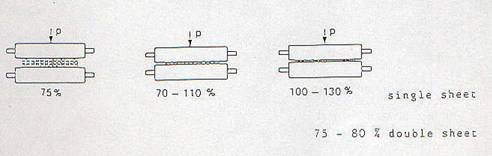
It must be mentioned that recommended dip and oxidation times on warp dyeing ranges are of little use if not the squeezing effect is taken into consideration. Under a given squeeze pressure, for instance 500 kg the squeezing effect of the mentioned 4- dyeing systems can be compared. We can see that similar squeezing effect can be achieved with the loop dyeing system 1 for 6 (75%) as with rope dyeing 70 – 110%. Double dyeing with 2 layers width with 150 cm gives approx. 80% squeezing effect, whilst single sheet slasher dyeing varies depending on count between 100 – 130%.

Loop dye 1 for 6 Rope-dyeing Slasher-dyeing
 
As only one short indigo dye bath is deeded only one feeding tanks, no separate feeding of chemicals is necessary.

Dye liquor is use in 1500 1 instead of 6-4500 1, therefore less chemicals are in use at same time. Lowe power consumption.

Fine counts can be dyed as well (No 30) For dark shades, black shades or other shades needed by fashion, other indanthrene dye stuff can be directly added into the indigo dye bath (indanthrene yellow or orange).

LOOP DYE 1 FOR 6 COMBINED WITH DYEMER

The demand for dark shades specially dark marine blue for super blue denims also led to new ideas in indigo dyeing ranges have been increased between 8-15 dye boxes with corresponding oxidation ranges.
In some cases Hydroxyaceton has been specially treated with high frequency. Besides achieving a darker shaded with the desire greenish touch it is very suitable for biological treatment. In order to achieve ring dyeing, mercerized yarn has also been used. Mercerizing prevents penetration of dye stuff into the inner code it is suitable for this purpose to obtain an optical blue effect and superior colour fastness and behavior in washing. Mercerizing is very costly, therefore new ways in continuous mercerizing and indigo dyeing was found.

DYEMER

The dyemer range is integrated.

For impregnation padder for hot caustic solution is placed after the heating system. The yarn is guided over cold cylinders and with an adjustable roller the tension of the yarn sheet can be adjusted according to the required tension prior to the scouring in 2 more boxes. After having passed this, the yarn sheet is immersed into the dye box and the same process as with the loop dye method is repeated.

CONTINUOUS DYEING AND SIZING ON THE DYEMER RANGE


If fashion needs other colours than indigo blue it is comparatively simply to dye and size on this range.

Monday, January 11, 2010

THE A-Z OF DENIM

The A-Z Of Denim
A complete A-Z glossary of denim terms from finishes, detail and weaves to mills, branding and history ...
A
ABRASION
Process of making garments look worn and aged by scraping or rubbing the surface of the fabric causing abrasion. Pumice stones are most frequently used by industrial laundries.
ACID WASH
(Marble/ Moon Wash/ Snow Wash)- This finish gives indigo jeans sharp contrasts. The process is achieved by soaking pumice stones in chlorine and letting these stones create contrast. The process was created in Italy and patented in 1986.
AGED
A kind of wet processing that gives the garment an artificial worn look and a softer feel through prolonged abrasion.
ANTI-TWIST
A step in the finishing process, before sanforization, that corrects denim’s natural tendency to twist in the direction of the diagonal twill weave. Also known as skewing.
AMOSKEAG
A New Hampshire factory town which was the first major source of denim in the US. The Amoskeag Manufacturing Company opened in 1838 and by 1900 claimed to be the world’s biggest textile producer; it later declined due to industrial unrest and competition from southern mills. On Christmas Eve, 1935 the Amoskeag Manufacturing Company closed abruptly closed its doors and filed for bankruptcy and a flood soon after crushed any hope of reopening. Denim from Amoskeag was prolific and hugely influential in the success of the fabric, being used exclusively for Levi’s® 501 until 1915.
ARCUATE
Distinctive double stitching used on the back pocket of the very first Levi’s® jeans, now acknowledged as the world’s oldest clothing trademark. The shape became synonymous with Levi’s® jeans by 1900, although it’s conceivable that other early work wear might have used the device before them. LS&Co. trademarked the stitching in 1943.
ATARIA
Japanese term describing the selective fading of the ridges of creases. The most common areas for ‘Atari’ are along side seams, on the front and back of the knees, the upper thigh, along the hem, on belt loops and along pocket seams.
AUTHENTIC
A jeanswear term used to describe both original jeans qualities and stone and enzyme wash optics. It became a marketing buzzword in the early 90’s, when the quest for original denim swept the European market. Among the characteristics of authentic jeans are traditional fabric weaves and styling details.
B
BACK CINCH
Also known as martingale, the back cinch with a back buckle was used to tighten the waist on jeans before widespread use of belts; hence the term ‘buckle back’. Most jeans makers abandoned them by 1942; with renewed interest in vintage-style looks, cinch backs have returned on modern jeans including Evisu, Atelier La Durance and Levi’s®.
BACK POCKET FLASHER
A paper or cardboard flap attached to the right back pocket of jeans and used to communicate differences in denims, washes, styles and size.
BARTACK
A sewing procedure that reinforces stress points on jeans- usually found near zippers and pocket openings.
BELL BOTTOMS
A jeans style born in the late ‘60s and popularized in the 70’s by brands such as Landlubber Jeans. This style was tight at the waist and thighs and the trousers flare out from the knee down. The name ‘bell bottoms’ presumably originates in the fact that the legs of these jeans take on the shape of a bell or trumpet when viewed from the side.
BELT LOOPS
Belt loops were first added to the waistband of the Levi’s 501 jean in 1922 to allow a belt to be worn without slipping. Both suspender buttons and the cinch back still remained on these first styles. A classic pair of jeans usually has 5 belt loops – 2 in front above the front pockets, 2 more at each side and one at the back.
BIG EA
term used to describe Levi’s® clothing made before 1971, at which time the all uppercase logo on the red tab was redesigned with a lower case ‘e’. Levi’s® jeans with a big ‘E’ are considered vintage and more valuable than later little e’s.
BLACK-BLACK DENIIM
Denim where the warp yarn is black instead of blue and which is also dyed black after weaving. this makes the jeans truly black rather than gray.
BLEACH
A chemical used to make denim fade. Liquid bleach is usually an aqueous solution of sodium hypochlorite, and dry powdered bleaches contain chloride of lime (calcium hypochlorite).
BOOT LEG
A popular jeans style cut wide enough in the leg to accommodate a pair of cowboy boots underneath.
BROKEN TWILL
A denim weave first used by Wrangler in 1964 as style 13MWZ. The diagonal weave of the twill is intentionally reversed at every two warp ends to form a random design. This type of weave reduces the natural torque characteristic of regular twill weaves, and has the effect of eliminating leg twist.]
BUDDY LEE
This cherub-cheeked ceramic doll, clad in Lee overalls, was introduced in 1920 as H.D.Lee’s first promotion. As popularity grew, the doll gained a larger wardrobe including cowboy duds and railroad uniforms. Production stopped in 1962 and today the dolls are favourites with collectors.
BULL DENIM
A heavyweight denim weave (14oz. plus) with a typical 3x1 twill construction. An ecru fabric, bull denim is later printed or garment dyed.
BUTTON
The traditional jeans button is made of two parts: a short ‘nail’ fixed on the fabric and the visible part pressed on the nail. It is typically made of a metal alloy- copper, brass or aluminium- and bears the brand’s logo, symbol or initial on its face. Some jeans buttons, composed of three parts, have a moveable head for better flexibility in fastening.
C
CASTE
A term that describes shading. Depending on the method and type of dye used, indigo denim can have a black, brown, gray, green, red, or yellow caste to it.
CELLULOSE ENZYME WASH
Enzymes which are like yeast , are used to physically eat away the cellulose in cotton. Since the colour in denim fabric is actually on the outside of the yard, when the denim is washed in a cellulose enzyme bath the indigo is removed along with the fiber. When the desired colour has been achieved, either changing the alkalinity of the bath or heating the water stops the enzymes from reacting. A rinsing and softening cycle follows. This process is more environmentally friendly than stone washing because strip-mined pumice stones are not used.
CHAIN STITCHING
A series of looped stitches that form a chain-like pattern. Chainstitching pulls the denim at slightly different tensions on either side, causing the distinctive ‘roping’ that really shows the beauty of worn indigo-dyed denim.
COIN POCKET
The fifth pocket, also called watch pocket. Strictly functional, it sits inside the right front pocket and justifies the term five-pocket jeans. Also known as match or watch pocket.
CONE MILLS
Cone Mills started producing denim in 1895 in Greensboro, North Carolina. The company started supplying denim for Levi’s® jeans in 1910, becoming the exclusive supplier for the 501 in 1922. Cone is still one of the world’s biggest denim manufacturers.
CROSSHATCH
A unique type of denim that shows a square grid-like pattern in the weave. It is created by mixing uneven yarns in both the weft and warp directions.
D
DENIM
A sturdy cotton twill fabric characterised by a 3x1 warp-faced weave in which the weft passes under two or more warp fibres producing the familiar diagonal ribbing, identifiable on the reverse of the reverse of the fabric. Traditionally denim is made with indigo-dyed yarn for the warp and natural yarn for the weft.Originally called Serge De Nimes for the French city where it was produced, denim is now manufactured in specialized mills around the world.Denim is an indigo-dyed cotton twill fabric, woven with a dyed warp yarn and a natural fill yarn. The term derives from Serge De Nimes; but denim and Serge De Nimes are in fact different fabrics.
DESIZING
An amylase enzyme rinse (desize) used to soften denim. A type of size such as cornstarch is added to the warp yarns prior to weaving in a process called slashing, which adds stiffness to the yarns. During the desizing step, the amylase enzyme attacks the starch and removes it from the fabric. Although this process reduces colour slightly, it is primarily used to give a softness and drapability to denim.
DIPS
Used to describe fabric or yarn when they are immersed in dye. Indigo yarns are usually dipped in an indigo bath six times.
DUAL RING-SPUN
Also called “ring X ring”. Signifies a denim weave in which both the warp and the weft threads are made of ring-spun yarn. Creates a much softer and textured hand than both open-end and regular (single) ring-spun denim. Due to the additional labour required to produce dual ring-spun denim, it is usually only used by higher end, premium denim labels.
E
ENZYMES
Enzymes, which are proteins present in all living cells, speed up chemical processes that would run very slowly if at all. They are non-toxic and readily broken down. Enzymes are used in textile processing, mainly in the finishing of fabrics and garments.
ENZYME WASH
Considered a more efficient and environmentally sound way to stone wash jeans. Rather than using pumice stones, organic enzymes (proteins) are used that eat away at the indigo. Jeans finished using enzymes tend to be stronger than those broken down by traditional stone washing, as the fabric is not subjected to the same level of abuse.
F
FINISHING
The techniques or processes performed on a garment, which give it it’s unique look.
FIVE POCKET JEANS
One of the most common styles of jeans; they have two back pockets, two front pockets and a coin pocket inside the right front pocket.
G
GARMENT DYE
A dyeing process performed on finished garments, as opposed to a yarn dye, which takes place prior to the weaving of yarn. If you see pocket linings or labels that look the same colour as the self-fabric, the garment was likely garment dyed.
H
HAND
A description of the way a fabric feels. A subjective judgement of the feel or handle of a fabric used to help decide if a fabric is suitable for a specific end use. The hand can be described as crisp, soft, drapable, smooth, springy, stiff, cool, warm, rough, hard, limp, soapy etc. Finishing and garment wash will affect the final hand of a fabric.
HANK DYEING
This is a very special dyeing process that very few people use. The yarns are loosely arranged in skeins or hanks. These are then hung over a rung and immersed in a dye bath being dipped in and out and left to oxidize in the air between each dip giving the yarns a natural irregularity of patina and caste. In this method, the colour penetration is the best and the yarns retain a softer, loftier feel.
I
INDIGO
The dye used for denim, initially taken from the indigofera tinctoria plant. It was synthesized 14 years after it’s chemical structure was identified by Adolf Bayer in 1897. Indigo’s inherent features are good colour fastness to water and light, a continual fading and it’s inability to penetrate fibers completely. This allows the blue colour in jeans made dyed with indigo to always look irregular and individual. Pre-1920’s jeans were generally dyed with natural indigo and were- as far as one can tell by comparing vintage examples- paler in colour, with a green cast. Later jeans were a darker blue, particularly used in combination with sulphur dyes. The majority of indigo used today is synthetically made. Natural indigo has a slightly red cast.
IRO-OCHI
Japanese term referring to the fading of indigo dye in denim. The term specifically relates to fading in exposed areas and not across the entire garment.
J
JEAN
The term is possibly derived from the French word ‘genes’. It was originally used to describe the type of pants worn by sailors from Genoa. While the historical definition implied that all jeans were made of denim, the term jeans today can sometimes refer to a garment that has five pockets and be made from fabrics such as corduroy, twill or bull denim.
K
KHAKI
Chinos, combat pants, military styles in khaki and olive- these became a popular replacement for jeans amongst the youth of the 90’s.
L
LAUNDRY
In the ‘Denim Industry’, a Laundry is a manufacturing company that takes unwashed jeans and processes them. This processing includes washing, stone washing, sandblasting, garment dyeing , finishing, use of ‘Tonello’ machine with abrasive bristles, applying enzymes to simulate a ‘whisker’ effect and sandpapering by hand. Laundries today are critical in making jeans look commercial and wash development has become as important as fabric development in the denim industry. The best Laundries and wash developments come from the U.S, Japan and Italy.
LEFT-HAND TWILL
Also known as an ‘S Twill’, this is a weave in which the grain lines run from the top left-hand corner of the fabric towards the bottom right. Usually in piece dyed fabrics, left hand twill fabrics are woven from single plied yarns in the warp. The denim brand Lee has always used left-hand twill denim as it’s basic denim. Left-hand twills will often have a softer hand feel to them after washing than right hand twills.
LEG TWIST
Many vintage jeans suffer from leg-twist. This is simply a natural adjustment of the fabric, which tends to follow the direction of the weave. Stefano Aldighieri, Director of Fabric & Finishing at LS&Co. explains it thus: “Levi’s® denim were mostly right hand twills; the twill line rises to the right. During the weaving process you basically ‘force’ the fabric to be straight, perpendicular to the selvage, but at the same time you give it this direction in the construction. You lay and cut the fabric; in the early days LS&Co. patterns were cut straight along the selvage. When you wash the garments, the fabric will try to follow the direction of the weave and will pull in that direction... hence the twisted legs, the result of the movement of fabric. Because Lee started to use left hand weave denims, their legs would twist the other way.” Leg twist was eliminated in the 1970s by skewing (which contorts denim to its after-wash shape)- and later revived with Levi’s® Red and Engineered jeans.
LOOP DYED
One of the three major industrial methods of dyeing indigo yarns. In the loop dyeing process, the yarn is dyed in a single bath instead of several. The desired depth of colour is attained by passing the yarn through the vat several times. Subsequently as part of the same process, the yarn is sized.
M
MERCERIZATION
An industrial process used on yarn or fabrics to increase it’s lustre and dye affinity. For fabrics used in the denim industry, mercerization can be used for keeping dye on the surface of the yarns or fabrics and to prevent dyes from fully penetrating the fibres.
MICROSANDING
In this fabric treatment process, a series of cylindrical rolls in a horizontal arrangement, either wrapped with an abrasive paper or chemically coated with an abrasive , are used to create a soft, sueded hand. The denim is pulled over the face of the sand rollers creating a raised surface finishinig. Some colour reduction is experienced.
N
NATURAL DYE
Up to to the middle of the 19th century there were only natural dyes and most of these these were vegetable origin. Natural indigo being one of the more important dyes. Natural dyes usually have no affinity for textile fibres until the fibres are treated with aluminum, iron, or tin compounds to receive the dye (mordanting). This is a problematic process and the dyes in any case have poor fastness to sun or abrasion.
NATURAL FIBRES
Any hairlike raw material directly obtainable from an vegetable, animal, or mineral source that can be converted, after spinning, into yarns and then into woven cloth.
O
OPEN END DENIM
Open End or OE spinning was introduced in the 1970s, reducing costs by omitting several elements of the traditional spinning process. The cotton fibres are ‘mock twisted’ by blowing them together. Open End denim is bulkier, coarser and darker, because it absorbs more dye, and wears less well than Ring Spun denim. Although cheaper to produce it has been used on many designer jeans, including Calvin Klein and Tommy Hilfiger.
OVERDYE
A fabric dyeing process in which additional colour is applied to the fabric or garment to create a different shade or cast. ‘Dirty Denim’ is often created by applying a yellow overdye to denim. By localising the application of the tint, you can create specific areas that look dirtier than the surrounding areas.
OXIDATION
Occurs when oxygen and another substance chemically join. This occurs when indigo yarn comes out of the bath between dips.
P
PIGMENT DYES
Dyes that do not have an affinity for fibre and must therefore be held to the fabric with resins. They are available in almost any colour and are used extensively in the denim industry by fabric dyers who want to create fabrics that fade more easily.
PLY
All yarns are single ply unless twisted with another yarn. Plied yarns are used to make yarns stronger. In the denim industry, it has become important to ply yarns stronger. In the denim industry, it has become important to ply yarns in piece dyed fabrics that are intended to endure a long stone wash cycle. The method of twisting and length of each yarn is a major determinant in the ultimate look and feel of the finished fabric.
POLYCORE DENIM
Often found in replica jeans, offers the best mix of strength (polyester core) and vintage aesthetic (cotton top thread layer).
PUMICE STONES
Volcanic stone used for stone washing garments. Pumice is popular because of it’s strength and light weight. Before the use of pumice, rocks, plastic, shoes and just about every other material was used to wear down and soften denim during the laundry process.
Q
QUALITY CONTROL
Each pair oj jeans is subjected to a series of quality checks. The first random samples are examined during pre-sewing. Then after the pieces are assembled, every single pair of jeans is individually examined, and again after washing.
R
RIGHT-HAND TWILL
Most denim is right-hand twill, a weave which produces a diagonal, or twill, line which rises from left to right. This was standard practice in weaving; single yarn warps were woven right-hand, double yarn warps were woven left hand. Most Levi’s® jeans are right-hand twill whereas most Lee jeans are left-hand twill.
RING DYEING
Describes a characteristic unique to indigo dye in which only the outer ring of the fibres in the yarn is dyed while the inner core remains white.
RING-SPUN DENIM
Ring spun yarns were traditionally used in denim up until the late 1970s, but were later supplanted by cheaper Open End yarns. This is a spinning process in which the individual fibers are fed onto the end of the yarn while it is in the ‘twisting’ stage. The process consists of a ring, a ring traveller and a bobbin that rotates at high speed. The ring-spun yarn produced by this method creates unique surface characteristics in the fabric, including unevenness, which gives jeans an irregular authentic vintage look. Ring-spun yarns add strength, softness and character to denim fabric.
RING-RING DENIM
Ring/Ring, or double ring-spun denim uses ring-spun yarn for both warp and weft. This is the traditional way to produce denim. It’s possible to combine a ring-spun warp fabric with an Open End weft, to get much of the strength and look of the traditional ring/ring denim at lower cost.
RIVER WASHING
A washing process using a combination of pumice stones and cellulose enzymes to give denim a vintage, worn hand. The washer is loaded only with stones and fabric for the first cycle. Enzymes are introduced for the second stage in combination with the stones and they are tumbled until a naturally aged look is produced.
RIVET
A metal accessory that is used for reinforcement of stress points as well as for non-functional ornamentation.
ROPE DYEING
Considered the best possible method to dye indigo yarns. The threads of denim yarn are twisted into a rope, which is then fed through sequence of being dipped into a bath of indigo dye, followed by exposure to air, multiple times. The frequency determines the ultimate shade of blue.
S
SANDBLASTING
A laundry process performed before washing in which jeans are shot with guns of sand in order to abrade them and cause a worn appearance. While originally done by hand this process is now automated at most large laundry houses.
SANDING/EMERSING
A fabric finishing process where fabrics are sanded with real sandpaper to make the surface soft without hair. It can be performed before or after dying.
SANFORIZATION
A pre-shrinking fabric process that limits residual fabric shrinkage to under 1%. The process includes the stretching and manipulation of the denim cloth before it is washed. Raw, un-sanforized jeans will shrink 7-10% after the first wash, and continue to shrink slightly up to the third wash. Developed in the late 1920s by the Sanforize Co. and patented in 1928, the process was reportedly first used by Erwin Mills in 1936 to make denim for overalls marketed under JC Penney’s Big Mac label. Lee jeans were made from Sanforized fabric soon afterwards, Lady Levi’s® introduced around 1935 were also Sanforized although most other Levi’s® jeans remained shrink-to-fit for another three decades.
SELVAGE
Also referred to as ‘Redline’ or ‘Aka-Mimi’. Originally called ‘self-edge’, the selvage is the narrow tightly woven band on either edge of the denim fabric, parallel to the warp. A selvage end prevents the edge of the denim from unravelling. Old 28 to 30 inch shuttle looms produce denim where selvages are closed, whereas on larger modern weaving machines, the weft yarn is cut on every pick, creating what is called a ‘fringe’ selvage. Coloured thread was used by Cone Mills to identify the particular fabric used by it’s major manufacturers. Vintage Levi’s® jeans began with an all white strip and later had a single red strip along both selvages, Lee’s had a blue or green strip along one end and Wrangler’s was yellow.
SHADE BATCHING
The process of selecting batches of fabric into homogeneous shade lots to obtain consistent colour continuity in garment making.
SHADE BLANKET
Fabric is cut from each roll of fabric and sewn together with roll numbers on the back of each roll. This is an important tool in cutting apparel made from denim to ensure that garments from the same shade group are cut.
SHRINKAGE
Traditionally before denim is woven, the threads it’s made of are treated with wax or resin to stiffen them and make them easier to weave (although with most repro denim starch is used instead.) When dry/raw/unwashed denim is washed for the first time the fibres constrict and the denim shrinks. Raw denim can be sanforized (treated with a sanforizing process that lessens shrinkage) but all raw denim will shrink to some degree upon immersion in water, up until it’s third wash.
SHED
During the weaving process, this is the opening formed by raising and lowering the warp yarns on a loom. The shed opening is what the weft yarns are passed through to complete the weaving interlace.
SHUTTLE
The device that carries the weft yarn across the loom in vintage shuttle looms. Selvage denim can only be woven using a shuttle loom.
SILHOUETTE
Refers to the shape of a garment (i’e bootleg, relaxed, low rise, slim, carpenter, etc...)
SIZING
Starch, gelatine glue or wax that is added to fabrics in the finishing stage to improve touch or weight and to help fabric laying in the cutting phase. Denim fabrics, for example can have almost one ounce of sizing.
SKEWING
Refers to the occurrence of twisting that happens when the fabric shrinks more perpendicular to the twill line than along the twill line. Without compensating for this occurrence, the twill line will cause the right angles that the fabric is woven in to torque approximately 5° after washing. To compensate for this, denim is skewed about 5° in the same direction as the twill line tom prevent the side seam from twisting to the front of the jean. You will often find authentic vintage jeans with one or both of the side seams twisted towards the front of the jean.
SLASHER DYEING
One of three main methods of dyeing indigo yarn.
SLIVER
In the yarn manufacturing process, a sliver refers to the loose, soft, untwisted rope of cotton fibers that is produced using the carding machine.
SLUB
Refers to thick or heavy places in the yarn. Slubs and other inconsistencies are common in denim produced on vintage shuttle looms. Modern yarn spinning technology is able to engineer these vintage looking textures into yarn in a predefined manner.
STONEWASHING
A process that physically removes colour and adds contrast. A 20 yard roll of fabric, generally 62 inches in width, is put into a 250-pound washing machine along with pumice stones. The fabric and stones are rotated together for a set period of time. The washing time dictates the final colour of the fabric- the longer the denim and stones are rotated the lighter the colour becomes and more contrast is achieved. The denim is then rinsed, softened and tumble dried. Both Marithe & Francois Girbau from France and the Japanese ‘Edwin’ claim to have pioneered this finishing technique.
SULPHER BOTTOM
Many manufacturers apply a sulphur dye before the customary indigo dye; this is known as Sulpher Bottom dyeing. This can be used to create a grey or yellow ‘vintage’ cast.
SUSPENDER BUTTONS
Attached to the waist bands of jeans to attach suspenders and braces these became less common from the late 30s when suspender buttons were removed to make getting dressed easier for the modern belt-wearing man. However many retailers stocked and fitted ‘Press On’ buttons for customers who preferred suspenders to a belt.
T
TATE-OCHI
Japanese term referring to occurrences of ‘Iro-ochi’ forming in vertical lines in vintage denim. As the thread width is not uniform in vintage denim, the colour fades the most where the thread is the thickest. This creates a white or severely faded thread of several centimetres along a single vertical indigo thread.
TOP STITCH
A commonly used straight simple stitch.
TWILL
The diagonal lines formed by the weave.
U
UNWASHED
Exactly what the word says- jeans that have been left unwashed, a characteristic that goes back to pre-sanforized days, when manufacturers sold their garments dark, stiff and not pre-shrunk. Some brands offer jeans this way for purists who want to break in their own jeans on their own bodies to recapture the original magic of denim’s good old days.
USED WASH
Term referring to a type of placed abrasive effect or sandblasting, made individually on each garment in special areas like the knees, pockets, thighs bottom etc...
V
VENETO
A Northern Italian region considered the cradle for some of the most successful names of the International jeans industry. Denim brands such as Diesel, Replay, Gas and Seal Kay were all born and raised here as were famous laundries such as Martelli.
VINTAGE
From the past; old or secondhand. Vintage jeans can either be previously worn or never worn and sorted in their original state
W
WAIST OVERALLS
The original term for what we know as jeans- Levi’s® continued to use this term up until the 1960s to distinguish their jeans from bib overalls.
WARP
This is the lengthways vertical yarns woven into the weft yarn. They usually have more twist and are stronger than weft yarns. In denim it runs parallel to the selvage and is dyed indigo.
WEAVE
The combination of warp and weft yarns woven into the weft yarns to produce different weave designs. The warp face designs used in the denim are called out by the number of weft yarns that the warp ends pass over followed by the number of weft yarns they pass under. Some of the most common denim weaves are 3x1 and 2x1 can be made in left or right-hand twill directions. 3x1 right-hand twill is the most common design.
WEFT
The un-dyed, crosswise filling yarns used in denim weave.
WEIGHT
Denim is traditionally graded by its weight per yard of fabric at a 29-inch width. Early Levi’s® were 9oz denim, increasing to 10oz in 1927; Lee 101 Cowboy Pants were introduced in the much heavier 13oz weight; most modern jeans are around 14oz.
WHISKERING
A fading of the ridges increases in the crotch area and back of the knees, which gives the appearance of aged denim. It can also be inverse- dark creased in faded denim.
X
XX
The name used originally to reference a particular model of Levi’s® jeans built prior to 1890. The XX has been present ever since and is used as both a lot or ordering number and to signify Levi’s® highest quality denim, ‘501 XX’, woven by Cone Denim.
Y
YARN DYE
Refers to fabric in which the individual yarns are dyed prior to weaving- denim is a yarn dyed fabric.
YOKE
V-shaped section at the back of jeans, also known as a ‘riser’, which gives curve to the seat. The deeper the V of the yoke, the greater the curve. Cowboy jeans often feature a deep yoke whereas workwear or dungaree jeans might have a shallower yoke- or no yoke at all.
Z
ZIP
The alternative to the button fly, first used for jeans by H.D. Lee in 1926. Wrangler was the first to do a centre zip fly for women in its Jeanie line, which debuted in 1950. The innovation was considered hazardous at first, but eventually became a huge success.
ZIPPER
A popular jeans closure. Also sometimes used as a design detail on back pockets or on tapered pants legs. The zipper was invented in 1893 by American W. Litcomb Judson as a system of small hooks and eyelets; it was improved by Swedish Gideon Sundback in 1913, when it became a system of small metallic teeth intertwined with a movable clasp.

Sunday, January 10, 2010

Sulphur Black Dyeing

                         Sulphur Black Dyeing in cotton and polyester
                 cotton blend quality in different Dyeing machine

Sulphur dyeing is used for dyeing of cotton and in market it is available in powder and liquid form also. In exhaust dyeing maximum powder form is used in dyeing of cotton material. In sulphur black dye main advantages it can cover immature cotton available in fabric portion and get lot of fashion shade. Even in Fabric
Dyeing general fashion is there if shade wise any major problem is there convert it sulphur black shade. Here in this article we are going to show the sulphur dye used in different machinery.

Drumming machine:

For garment micro garment quality was used (50% polyester and 50% cotton blend quality) one trail was observed in 50 kg lot.

Quality:-micro garment quality (50% polyester and 50% cotton blend quality)
Quantity:-50 kg M; L:-1/15
M/c used:-Drumming m/c Order:-For local quality.

Process used:

I) Desizing agent (Enzyme) =200 gram Lubricant =500 gram OT =200 gram (Run at 55 degree Celsius, 20 minute holding time.)--------Washing---------

II) Lubricant = 500 gram Sulphur Black =4.500 kg Sodium Sulphide=4.500 kg Common Salt =10 kg Soda ash =700 gram (65-70 degree Celsius, holding time 30 minute)----Washing----

III) Hydrogen peroxide=700 gram Acetic Acid=400 gram (10 minute holding, cold) IV) Bio-polishing:- Bio-SL (Enzyme) =400 gram Lubricant=500 gram Acetic Acid=800 gram (Holding time 30 minute, at 50 degree Celsius)----Washing---washing----unloading for finishing section.

Note: Acetic Acid quantity was taken more because water PH is alkaline coming range 8.0-8.5. From above it was observed three processes was involved .

Desize----sulphur dyeing---oxidation---bio-polishing—washing---washing .

The above lot within 2 hours was taken out. Result was satisfactory for local quality within short time getting result.

Continuous Dyeing machine:

For Cotton Twill quality (Drill quality) Order:-Export Quality.

I) Sulphur Black dye=95 gpl Crypto-anionic wetting agent=2 gpl Antimigrating agent=10 gpl Padding----drying-----Chemical padding

II) Chemical Padding:- Soda ash=20 gpl Sodium Sulphide=95 gpl Padding—steaming—cold wash-oxidation

III) Oxidation:- Potassium dichromate=5 gpl Acetic acid=2 gpl (50-55 Degree Celsius)

IV) Soaping;- Soap=0.5 gpl Soda ash=0.5 gpl (85-90 Degree Celsius)--------hot wash—hot wash—cold wash—drying.

Final process:-

Dye Padding—drying in hot flue drier---chemical padding---steaming—cold wash—oxidation—soaping—hot wash-hot wash –cold wash—drying and batching for finishing.

(For Fabric neutral PH if required slight acetic acid can be taken in last washing tank)

Jigger Dyeing machine:-

For Drill cotton Quality (For 100 kg lot). Order:-Local Quality

I) Sulphur Black dye (Powder) =6-8% Sodium Sulphide=1.5 part of dye quantity. Common salt=10 kg Soda ash=2 kg First Dye-2 Turn (Room Temp) Sodium sulphide=2Turn (Room Temp) +4Turn (Boil) + Common salt=4Turn (Boil) (Salt Addition in two installment) + Soda ash=4Turn (Boil) (Soda Addition in two installment)

II) Oxidation:- Hydrogen Peroxide=2 gpl Acetic acid=1 gpl (50-55 degree Celsius, 4Turn running drain)

III) Soaping:- Soap:-0.5 gpl Soda ash=0.5 gpl (80-85 degree Celsius, 4turn running drain) Hot wash—2Turn---Hot wash=2Turn (Fresh water) ---cold wash—unloaded.

Final process: -

Dye drain---cold wash---oxidation---soaping—hot wash—hot wash—cold wash—Unload.

Soft Flow Machine sulphur black recipe:-

For Knitting Single Jersey Cotton Fabric (GSM=100):- For 150 Kg lot

I) Dyeing Recipe:- Sulphur Dye=14.700 kg Sodium Sulphide=14.700 kg Common salt=7.5 kg Soda ash=1.5 Kg (Dyeing at boil)

II) Oxidation Recipe:- Hydrogen Perioxide:-1 liter Acetic acid:-2.5 Kg (55-60 Degree Celsius)

III) Soaping Soap =0.5 gpl Soda ash=0.5 gpl (Boil)

IV) Hot wash—hot wash—cold wash—hydro exacter—drying.

Final Process:-

Dyeing---cold wash---oxidation—soaping---hot wash---hot wash—cold wash—hydro exactor---drying. (Washing can be increased if color bleeding is observed)

First lab trail has to taken then go for bulk trail. This article has been written in good faith just sharing our experience in production area in different machinery section.